A controversy that erupts every year.
Every year, when it’s time to change the clocks either back or forward one hour, I wonder what the pros and cons of Daylight Saving Time (DST) are. When would you prefer to have your extra hour of sunlight?
Some facts about DST:
DST refers to advancing the clocks by one hour during warmer months, hence “Springing forward”. Benjamin Franklin invented the concept in 1784 believing that rising earlier would economize candle usage and save people money. Pushing the clocks forward would make greater use of daylight during the warmer months. The idea was formally adopted during World War 1 as part of a global attempt to conserve energy.
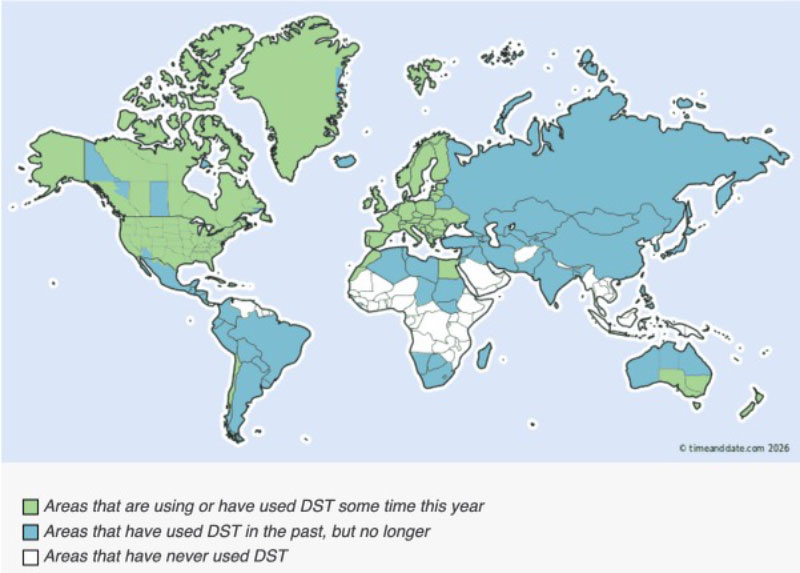
 https://www.timeanddate.com/time/dst/statistics.html
Currently, 70 countries, about 40% of all countries, use DST. About 140 countries have used DST at some point, but about half of them have abandoned it. It has always been controversial.
In the U.S. debates on its use arise every year. Since 2015 over 200 DST-related bills have been introduced in nearly every state. One year, legislation was proposed to move all U.S. time zones forward by 30 minutes, as a compromise. It did not pass.
Some states have voted to have permanent DST. Federal law currently only allows states to opt out of DST or stay on it year-round. Congressional approval is required for any change.
A recent tidbit of information on DST is that on February 27, 2026, British Columbia, Canada, passed legislation to move clocks forward for the last time. In the future they will no longer adjust their clocks in the fall and spring.
Pros
DST does not create more daylight, it simply shifts when the daylight falls. Moving clocks forward by one hour transfers an hour of morning sunlight to the afternoon.
Those in favor of DST argue that the longer evenings allow people to get outside, exercise, and enjoy outdoor recreation, which is a healthier lifestyle.
More light equals more safety. Road safety increases, and pedestrian fatalities decrease about 13% during dusk hours. A study found that robberies also decrease 7% following the shift to DST.
Tourism benefits from lighter evenings with people shopping and going out to eat.
Cons
Although originally conceived as an energy-saving measure, as the world has evolved, lighting accounts for less of overall energy consumption. More use of air conditioning and heating makes any beneficial effects of DST energy consumption negligible.
The time change means disruptions in the sleep patterns of over 300 million people. 48 states observe DST, with Arizona and Hawaii opting out. Surveys from the American Academy of Sleep Medicine (AASM) show that 63% of Americans would prefer standard time all year round, and 55% experience tiredness. Other studies show that car accidents increase, and fatal car accidents increase by 6%. Mood disturbances, anxiety, substance abuse, and hospital visits increase, as do strokes and heart attacks.
People are not as attentive as they should be during the increased hours of darkness at either the beginning of the day, or the end.
Many health experts feel that humans function best when our sleep cycle follows the sun. We get sleepy when it gets dark because we release melatonin. In the spring, when we switch to DST, we increase the amount of light we’re exposed to in the evening. Waking up in the dark and having more light when it gets dark means we are misaligned with our internal clocks.
Finally, some data to help with a decision:
About eight months ago, Stanford Medicine scientists released a new analysis that showed that by changing the clocks twice a year, our circadian rhythms are disrupted which leads to higher rates of stroke, heart attacks, fatal car accidents, and obesity. Circadian rhythm is the body’s innate, 24-hour clock, which regulates many physiological processes. The Stanford Medicine researchers investigated the three most common time schedules: Keeping permanent standard time (what we have in the fall), keeping permanent daylight saving time (what we have in the spring), or continuing the twice yearly changing of the clocks which we have now.
Here is a broad summary of their findings from the Stanford Medicine News Center:
“The team found that, from a circadian perspective, we’ve made the worst choice. Either permanent standard time or permanent daylight saving time would be healthier than our seasonal waffling, with permanent standard time benefitting the most people.”
Is this the person who might have found the solution to DST controversy?
 PhD, professor of psychiatry and behavioral sciences and senior author of the study that published Sept. 15 in the Proceedings of the National Academy of Sciences.
“We found that staying in standard time or staying in daylight saving time is definitely better than switching twice a year,” said Jamie Zeitzer.
Well, there you have it. Here’s a little more explanation to support their pick of staying in standard time, from the Stanford Medicine News Center:
“By modeling light exposure, circadian impacts, and health characteristics county by county, the researchers estimate that permanent standard time would result in some 300,000 fewer people having suffered from a stroke and result in 2.6 million fewer people having obesity. Permanent daylight saving time would achieve about two-thirds of the same effect.”
Prior to this study there was very little data to support any decision on DST. Stanford Medicine’s research seems thorough and conclusive to me, although I do get excited when it’s time to “spring forward” even though I understand we’re not actually getting more daylight, just shifting around when we get it. This study also showed that “You generally need more morning light and less evening light to keep well synchronized to a 24-hour day.” Jamie Zeitzer
I’m sold, but there are people who passionately support the opposite conclusion, so it’s uncertain if any actual change will come.
In the meantime, here are some tips to help your body adjust to time changes:
- Gradually shift your sleep and wake times by 10-15 minutes earlier each day, starting a few days prior to the switch.
- Get outside for sunlight as soon as you wake up or sit by a bright window to help your internal circadian rhythm reset.
- Go to bed and wake up at the same time, even on weekends, to normalize your sleep schedule.
- Your bedroom should be dark and quiet. Avoid caffeine and alcohol within 3 hours of bedtime.
- Get moving in the morning to increase alertness and manage fatigue.
Apps that help us to adjust to time changes:
 Better Sleep (for iOS and Android) offers sounds and trackers to adjust to time changes and reduce restlessness.
 Endel (iOS and Android) uses AI to generate sounds based on circadian rhythms, helping the body adjust to light changes.
 SleepScore (Android/iOS): Features a specific four-day program to prepare for time changes using sonar technology via your smartphone to track breathing and movement.
 Time Buddy (iOS): Visual world clock that provides DST warnings and auto-updates time zone databases.
 Alarmy is the top-rated “loud alarm clock” app designed for heavy sleepers, available on iOS and Android. It forces you to wake up using math problems, shaking, or scanning a QR code. The app also includes sleep trackers and calming sounds.
 This app is only for iOS and is free. Users can check the switching date of DST and standard time around the world.
A
The post The Pros & Cons of Daylight Saving Time appeared first on Sharp Eye.

Leave a Reply